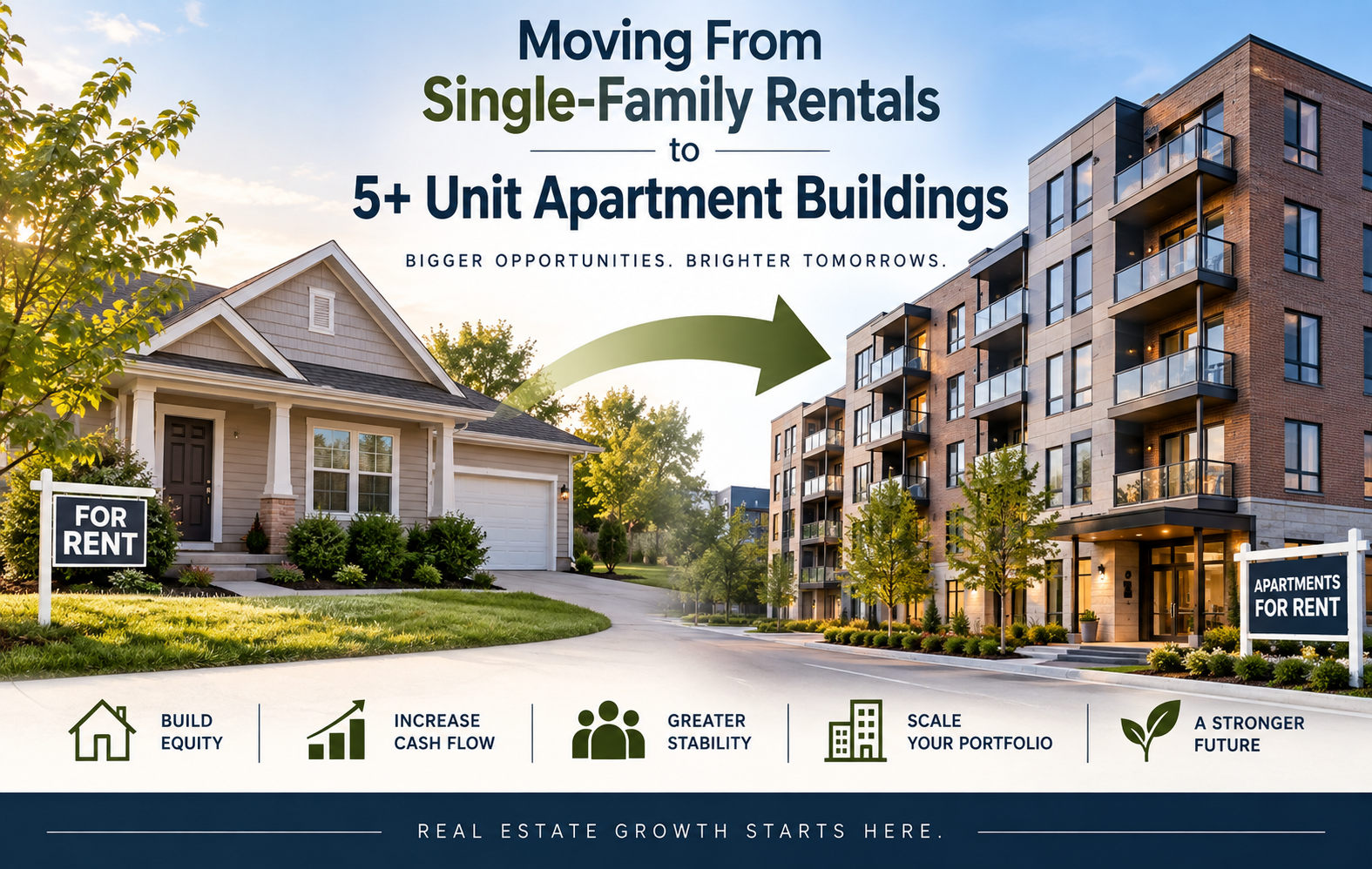
How CMHC financing can change the economics of multifamily investing
For years, the traditional path for Canadian real estate investors has been simple:
Buy a house. Rent it out. Build equity. Repeat.
But for investors who have accumulated significant equity, buying another single-family rental may no longer be the most efficient way to grow.
At Filament Commercial Real Estate, we believe Ottawa investors should understand the opportunity presented by 5+ unit apartment buildings—particularly the role of CMHC financing.
Why Scaling Single-Family Rentals Can Become Difficult
Single-family properties are familiar and relatively straightforward to finance. However, every new acquisition requires additional capital for:
- Down payments
- Closing costs
- Renovations
- Financing
- Maintenance
- Property management
Because each property provides only one rental income stream, investors must repeat the process with every purchase.
Eventually, the challenge is not finding opportunities. It is deploying capital efficiently.
Why 5+ Units Changes the Equation
A property with five or more residential units enters the multi-unit residential financing market. This can open the door to CMHC-insured financing programs designed specifically for apartment buildings.
Unlike a single-family property, an apartment building is evaluated largely on its income-producing potential.
You’re no longer just buying a property. You’re buying an income-producing business.
Eligible CMHC financing may offer:
- Higher leverage
- Longer amortization periods
- Competitive interest rates
- Financing based substantially on property income
- The ability to control a larger asset with less equity
CMHC’s MLI Select program may provide additional financing benefits for eligible properties that meet requirements related to affordability, energy efficiency and accessibility.
The exact terms depend on the property, borrower, lender, underwriting and applicable CMHC requirements. The key idea is that CMHC financing can help investors use their equity more efficiently.
A Simple Example
Consider an investor with $1 million available to invest.
That capital could be spread across several single-family rentals, with each property requiring its own down payment and closing costs.
Alternatively, the investor could explore a larger apartment building supported by CMHC-insured financing. Depending on the property and financing structure, the same equity could potentially help acquire a significantly larger income-producing asset.
The investor may be able to control more real estate while benefiting from multiple rental income streams under one roof.
Multifamily Value Is Tied to Income
With a single-family property, value is primarily determined by comparable sales.
An apartment building is different. Its value is strongly influenced by Net Operating Income (NOI) and the market capitalization rate.
For example, if a building generates:
$200,000 of annual NOI
And comparable properties trade at a:
5% capitalization rate
The implied value is approximately:
$200,000 ÷ 5% = $4,000,000
If the owner increases NOI to $250,000 through improved rents, expense management or operational changes, the value at the same cap rate becomes:
$250,000 ÷ 5% = $5,000,000
That is a potential $1 million increase in value.
This is one of the biggest mindset shifts in multifamily investing: income and value are directly connected.
You Don’t Need to Be a Large Developer
Multifamily investing is not limited to institutional investors. Ottawa and Eastern Ontario have apartment buildings with five, six, eight, ten and more units that may be suitable for private investors.
Investors who have built single-family portfolios may already understand many of the fundamentals:
- Tenant management
- Operating expenses
- Rents
- Contractors
- Financing
- Maintenance
- Real estate risk
The difference is scale. Instead of managing one rental unit in one house, you are managing multiple units within one asset.
When Should You Consider the Transition?
There is no universal net-worth threshold, but it may be worth exploring 5+ unit properties if:
- You have accumulated meaningful equity
- You are comfortable managing rental properties
- You want to scale your portfolio
- Down-payment requirements are limiting your growth
- You want multiple income streams under one roof
- You are interested in increasing NOI
- You want to build a larger real estate business
The next step may not be another house. It may be an apartment building.
Multifamily Still Requires Careful Analysis
Multifamily is not automatically better. Larger properties have more moving parts and require careful evaluation of:
- Rents and vacancy
- Operating expenses
- Property taxes and insurance
- Repairs and capital expenditures
- Building condition
- Financing
- Zoning
- Market rents
- Environmental considerations
- Exit strategy
CMHC financing does not turn a poor property into a good investment. It can, however, make a strong multifamily opportunity more efficient to finance.
Why Work With Filament?
At Filament Commercial Real Estate, we help Ottawa and Eastern Ontario investors evaluate multifamily opportunities from both a real estate and financing perspective.
Our process includes:
Find the property → Analyze the numbers → Evaluate the upside → Structure the financing → Acquire → Stabilize → Grow
We encourage investors to consider the financing strategy before making an offer, not after. The right structure can make the difference between pursuing an opportunity and walking away from it.
Ready to Explore Multifamily?
If you have built equity through single-family rentals, let’s explore what that equity could do in the multifamily market.
Contact Filament Commercial Real Estate to discuss your next apartment acquisition.
CMHC financing is subject to applicable program requirements, underwriting, lender approval and CMHC approval. Financing terms, loan-to-value ratios, amortization periods and program requirements vary by property and borrower and are subject to change. This article is for general informational purposes and should not be considered financial, legal or lending advice.
For more information, call 613-691-9901 or email